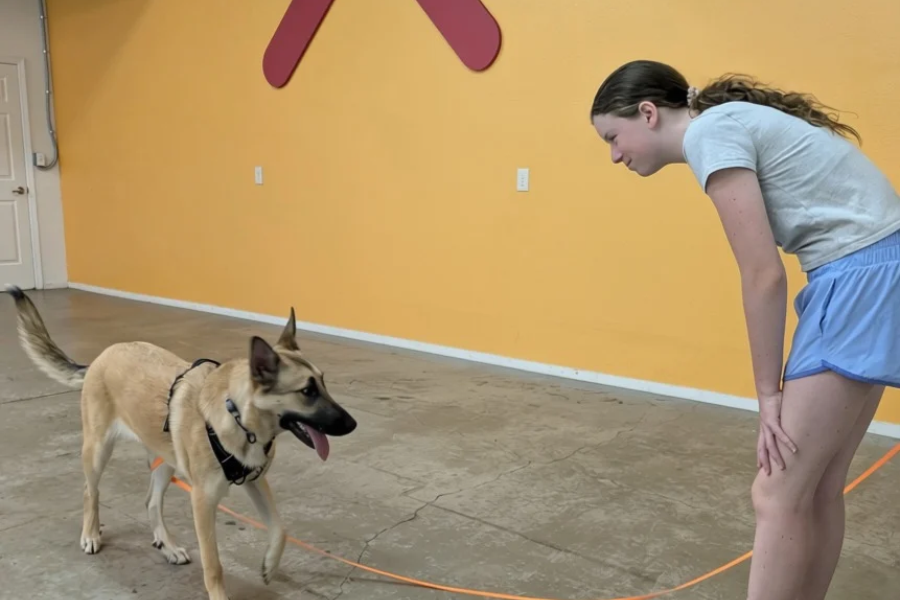
Your Dog Isn’t Giving You a Hard Time. They’re Having a Hard Time.
by Wendi Piscia | October 9th, 2026 | 4:15 pm
Halloween is just around the corner. Soon, neighborhoods across Napa County will fill with costumed children, ringing doorbells, glowing decorations, and excited visitors. For people, it can be one of the most enjoyable nights of the year.
For many dogs, however, Halloween can feel very different.
Imagine the experience from a dog’s perspective. All evening, strangers approach the house. The doorbell rings repeatedly. Children move unpredictably. People wear masks and costumes that make them look and sound unfamiliar. The normal household routine disappears. Even a confident dog may find the experience confusing or stressful.
This is often when families begin to notice behavior they do not see the rest of the year. A dog that is normally friendly starts barking at the door. Another hides under a table when visitors arrive. Some dogs pace, whine, or seem unable to settle down. Others may growl, retreat, or refuse to interact altogether.
When these things happen, it is easy to assume a dog is being difficult or misbehaving.
But what if we looked at the situation differently?
What if your dog is not giving you a hard time?
What if they are having a hard time?
One of the most important things pet owners can understand is that behavior is communication. Dogs are constantly telling us how they feel about the world around them. The challenge is that humans often notice only the loudest forms of communication.
Most people recognize barking, growling, lunging, or hiding. Those signals are obvious. What often goes unnoticed are the smaller signals that come first.
A dog may turn their head away when someone approaches. They may lick their lips even though no food is present. They may yawn repeatedly despite not being tired. Some dogs avoid eye contact. Others become unusually still, try to leave an interaction, or show the whites of their eyes.
To the average person, these behaviors can seem insignificant. In reality, they are often early signs that a dog is uncomfortable.
Think of it as a conversation. The dog is communicating, but we may not be listening.
Imagine a visitor reaches down to pet a dog. The dog looks away. The visitor moves closer. The dog licks its lips and shifts its body. The visitor continues trying to interact. The dog attempts to move away. Finally, the dog growls, or worse.
To the dog, the growl was not the beginning of the conversation. It was simply the latest message in a series of signals that had been communicating discomfort all along.
To the human observing the interaction, the reaction may seem sudden or unexpected.
This misunderstanding happens every day, not just at Halloween.
A dog who is uncomfortable around visitors may be labeled unfriendly. A dog who barks at unfamiliar sounds may be called stubborn. A dog who avoids certain situations may be viewed as disobedient.
But behavior rarely appears out of nowhere.
There is usually something driving it.
Fear, stress, anxiety, uncertainty, excitement, frustration, or even physical discomfort can all influence how a dog behaves. When we focus only on the behavior itself, we often miss the reason behind it.
That is why behavior support is such an important part of animal welfare.
Many of the challenges people experience with their dogs begin as small misunderstandings. A dog communicates discomfort. The signals go unnoticed. The dog escalates their communication. Frustration develops on both sides. Over time, a manageable concern can become a bigger problem.
The good news is that many of these situations can be improved when people learn to recognize what their dogs are trying to tell them.
Take growling as an example.
Many people view growling as bad behavior that should be corrected immediately. While a growling dog should always be taken seriously, the growl itself is often valuable information. It tells us the dog is uncomfortable and needs more space, distance, or support.
When a growl is punished, the underlying emotion usually remains. A fearful dog does not stop feeling fearful simply because they were corrected for growling. In some cases, the dog may learn not to provide a warning at all.
A better approach is to ask a simple question: Why is this happening?
Understanding the answer often leads to better solutions.
This is where Halloween provides a useful opportunity to think differently about our dogs’ needs.
If your dog becomes overwhelmed by a constant stream of trick-or-treaters, consider giving them a quiet room away from the front door. If costumes make them nervous, do not force interactions. If children are visiting, supervise carefully and make sure your dog always has a way to move away from situations that make them uncomfortable.
Not every dog wants to greet visitors. Not every dog enjoys crowds. Not every dog wants to pose for pictures in a costume.
And that is okay.
One of the most compassionate things we can do as pet owners is respect what our dogs are communicating.
At Napa Humane, we often talk about prevention in the context of medical care. We discuss vaccines, wellness exams, parasite prevention, and spay and neuter because preventing problems is usually easier than solving them later.
Behavior works the same way.
Helping people understand canine communication can prevent manageable concerns from becoming more serious challenges. It can reduce bite risks, strengthen the relationship between people and their pets, and help keep dogs successfully in the homes where they belong.
If you are struggling with a behavior concern or simply aren’t sure what your dog is trying to tell you, Napa Humane offers a free behavior helpline to help pet owners better understand their dogs and determine appropriate next steps. You can learn more at bit.ly/NHBehaviorHelp
The reality is that most dogs are not trying to be difficult.
They are simply responding to the world around them with the tools they have available.
As Halloween approaches, I encourage pet owners to pay attention not only to what their dogs are doing, but also to what they may be trying to say. A barking dog, a retreating dog, or even a growling dog is often communicating something important about how they feel.
When we learn to recognize those messages, we put ourselves in a better position to respond with understanding instead of frustration.
And sometimes that simple shift in perspective changes everything.
Because your dog may not be giving you a hard time.
They may simply be having a hard time.